

Carpenter Ant Control in Metro Vancouver
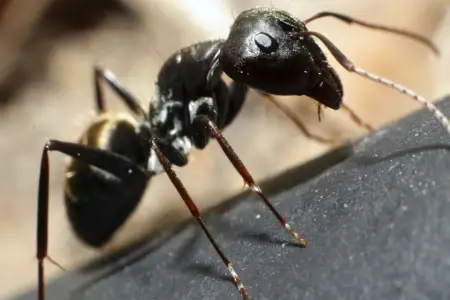
How to identify carpenter ants
Carpenter ants don’t eat wood — they excavate it. And because their nests usually sit inside exterior walls, sills, and framing, most homeowners don’t know they have a problem until they spot the ants themselves or notice a trail of wood shavings that shouldn’t be there.
Metro Vancouver’s damp coastal climate is exactly the kind of environment carpenter ants look for. You don’t need a house that’s falling apart for them to move in — a persistently damp sill plate or a leaky gutter is often enough.
Carpenter ant inspection are always free of charge.
How to Tell If You Have Carpenter Ants
Carpenter ants are large — 6 to 12mm — and either solid black or a reddish-brown-and-black combination, depending on the species. That size is the easiest way to rule out a false alarm: the small black ants most people see on patios and driveways in summer are pavement ants, a different (and far less destructive) species that nests in soil, not wood.
| Pavement ant | Carpenter Ant | |
|---|---|---|
| Colour | Black | Reddish-brown and black, or solid black |
| Size | 2.5–4mm | 6–12mm |
| Nest location | Underground: Soil, under pavers and driveways | Wood: Framing, sills, siding, trim |
| Most active | Late spring–early summer | April through October (occasionally as early as late January) |
Two species turn up most often in this region: Camponotus modoc (solid black, typically one queen, one parent nest) and Camponotus vicinus (reddish legs and thorax, capable of multiple queens and multiple parent nests). Vicinus is the more aggressive colonizer of the two and tends to establish satellite nests faster.
Signs to check for:
- The ants themselves — especially indoors, especially in numbers. A few scouts near a door isn’t alarming; a steady trail is.
- Frass — a sawdust-like material, often found on windowsills, in cobwebs along the foundation, or piled beneath baseboards and trim. This is the single most reliable sign of an active nest nearby.
- Faint rustling sounds inside walls, particularly at night when the colony is most active.
- Winged ants indoors — a sign a mature nest exists somewhere in the structure and is producing reproductives.
Carpenter ants or termites?
Both leave behind wood damage, but the tunnels tell you which one you’re dealing with. Carpenter ant galleries are smooth and clean — they polish their tunnels as they go. Termite damage is rougher and often has mud or soil packed into it, since termites build with soil rather than just removing wood. If you’re not sure which you’re looking at, that’s exactly what a free inspection is for.
Why Homeowners Choose 1st Pest Control
- Free inspections and quotes, residential and commercial
- Transparent pricing — you know the cost before we treat
- Licensed, experienced technicians who explain what they’re seeing, not just what they’re spraying
- Low-toxicity, targeted methods — safe for kids and pets
Carpenter Ant Prevention Tips

Keep the buffet out of reach
One of the best ways to keep carpenter ants away is simple: give them nothing to come for. These ants have a serious sweet tooth, and they’re surprisingly good at sniffing out sugary food sources — including the nectar in flowering plants like clematis. We’re not suggesting you tear out your garden (plants and insects both play an important role in a healthy yard!), but it’s worth keeping vegetation a few inches clear of your siding and foundation. Even that small gap can make your home a lot less appealing to hungry ants.
Carpenter ant or something else?
If you’re spotting a lot of ants around your house and wondering whether they’re a threat to the structure, the first step is figuring out what species you’re dealing with. In Metro Vancouver, the two carpenter ants to watch for are Camponotus modoc (solid black) and Camponotus vicinus (reddish-brown and black). Both are larger than your average sidewalk ant, growing up to half an inch long, and the queen is even bigger, reaching nearly a full inch. If you’re seeing ants that size, it’s worth a closer look.
Service Area
We treat carpenter ant infestations across Metro Vancouver and the Lower Mainland, including Vancouver, Burnaby, Coquitlam, New Westminster, Surrey, Richmond, North & West Vancouver, and surrounding communities.
FAQs

New to 1st Pest Control?
Enjoy 10% OFF your first treatment service. (*)
Enter Code NEW10 in the contact form

(*) Terms and Conditions
- This discount does not apply to carpenter ant treatments, exclusion work, Ekomille trials, or rodent inspections.
- Discounts must be claimed/mentioned at the time of initial contact to be honoured.
- This offer does not apply to treatments or services valued at $2,500 or more.
